Nirvikalpa and Beyond
Traveling the Seven Planes of Consciousness
Nirvikalpa and Beyond presents a direct tantric exploration of nirvikalpa samadhi as the cessation point where individual identity dissolves into the Ocean of Consciousness. Mark Griffin maps the descent of Shakti, the structure of the subtle channels, and the experiential threshold beyond conceptual mind, revealing enlightenment as a physics of alignment within the architecture of Yoga Tantra.
Duration: 55:39 / 11 Pages
You can become a member today to access this audio teaching from our growing archive, or purchase it from the Hard Light Center of Awakening bookstore.
IN THIS TEACHING
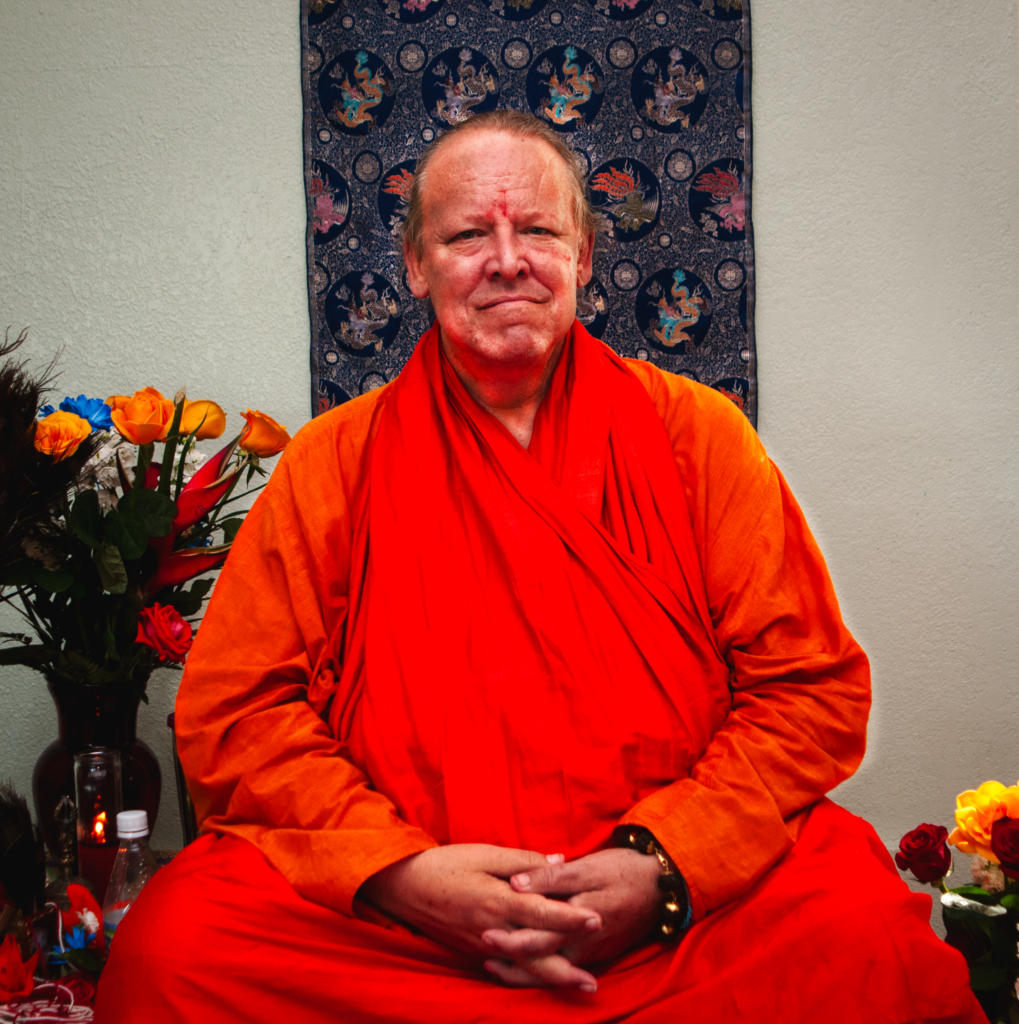
"So I call this session Nirvikalpa and Beyond, because the session begins in the Nirvikalpa. We will simply be sitting in that space, that state and stage, throughout the day; and allow it to pour into us and fill the vase of our respective assemblies of body, speech and mind."
Meditation Master Mark Griffin
Nirvikalpa and Beyond is a “God Intensive” devoted to meditating directly on the Absolute. Griffin frames nirvikalpa samadhi as the point of cessation—where the assembled identity of the individual perceiver (the complexity of the four bodies) becomes equal to the Om-point, the place where the vibration of creation comes to rest and the “drop” of manifestation is absorbed back into the Ocean of Consciousness. In this view, the Om-point is not merely symbolic: it is an experiential “organization point” in deep sahasrara, described in relative language as a space “over the crown of the head,” where relativity itself breaks down.
The talk unfolds the core metaphysics of yoga tantra: the Ocean of Consciousness continuously conducts itself into creation and back again along the innermost channel of awareness. This conduction is mapped onto the SoHam current: So assembles at the base of the spine as the vibration of creation (absolute unconsciousness as manifestation), while Ham abides at the crown as the vibration of pure consciousness (absolute consciousness as Ocean). Griffin highlights a threshold between the third eye and the crown, a “place of void,” where a membrane-like interface allows emptiness to descend into the created field and seize the three rivers—ida, pingala, and sushumna—bringing the entire human circuit board into a single alignment.
A defining feature of this Intensive is that it begins in nirvikalpa rather than building toward it. The day’s meditation is presented as an immersion in the nirvikalpa field “pouring from above,” like a divine elixir filling the open vase of the human form. Here, “nirvi-” is glossed as “without sign / without mind,” emphasizing that what cannot be conceived cannot be approached by conceptual effort; it is approached as cessation itself, a practice of alignment and “getting out of the way.” Griffin repeatedly recasts surrender in contemporary language: not passivity, but the precise act of removing interference so the Shakti can do its work.
He situates nirvikalpa within a wider cosmology of seven planes (lokas), rising from the firmness of earth toward the Om-point as the seventh plane—the terminus where the mind extinguishes. As attention ascends through these planes, the architecture of identity progressively loses its ability to assemble; beyond a certain threshold, even the body-concept dissolves. The higher planes are described as refined modifications of Infinite Consciousness—“paradises” that can be entered as one’s nature is transformed into their vibrational key. Yet the teaching warns against “pogo-sticking” upward into bliss as an escape; the created field cannot be escaped, only transformed—the unconscious must be made conscious.
The transformation engine is Shaktipat as contact. Griffin explains the Intensive as a direct introduction of enlightenment into the mind-stream: once the Om-point is contacted, the system cannot remain in a vacuum of separation and must come into equilibrium with that level of reality. The consequence is stark and uncompromising: contact with the Om-point is irresistible—it cannot be reasoned away or negotiated. In this framing, spiritual practice is not a belief system but a physics of alignment: the vessel is designed for enlightenment, with all seven planes “hard-wired” into the human form.
The talk gives a detailed energetic map for practice. The descending waves of Shakti are said to flood the channels, saturating the right side (pingala, sun, linguistic/matrika currents and autonomic functions) and the left side (ida, moon, emptiness and the “ah” vibration of mind), then drawing everything into the central nadi of sushumna, where merging occurs. The chakras are treated as elemental circuit points—earth, water, fire, air, ether—through which the descent anchors into the base and into the earth itself. Gravity (apana) becomes an ally: the deeper one draws the Self downward through the body, the more stable the descent of the Ocean becomes.
“Beyond” nirvikalpa is introduced through the language of the Guru Gita: beyond the Rupa / Blue Pearl (the last assembly between Ocean and creation) is Rupatitam, a formlessness so subtle that mind itself cannot grasp it without overlaying it. This “beyond” is presented not as another object of experience but as the deepest meaning of emptiness—God beyond qualities, beyond conception. The day’s practice therefore oscillates between two bhavas: the urge to participate and direct what’s happening, and the radical efficiency of surrender, which Griffin calls “jet fuel” for crossing the Great Ocean.
The Intensive concludes by returning to the Om-point as the simultaneous arising of infinite expansion and infinite contraction, infinite consciousness and infinite unconsciousness—the mystery of God appearing within the practitioner “as us.” The offering of prasad as ganachakra seals the day as both celebration and transmission: a recognition that the Absolute is not elsewhere, but descending, saturating, and extinguishing the mind into its source.

Member Access
To listen to the full audio and access the teaching materials, please log in or become a member.